Blackjack strategy chart
The blackjack strategy chart and cheat sheet, with the rules that change it
Basic strategy for hard totals, soft totals and pairs, laid out as a proper grid rather than a paragraph, so it works as a cheat sheet you can keep open. Flip the rules below, dealer hits or stands on soft 17, double after split allowed or not, surrender offered or not, and watch which cells move.
Assumes a standard 4 to 8 deck shoe throughout, only these three rules shift the chart.
Dealer's up card runs along the top of each table (2 through 10, then Ace). Your hand runs down the side.
The full blackjack basic strategy chart: hard totals, soft totals and pairs
Hard totals
| 2 | 3 | 4 | 5 | 6 | 7 | 8 | 9 | 10 | A | |
|---|---|---|---|---|---|---|---|---|---|---|
| 8 | H | H | H | H | H | H | H | H | H | H |
| 9 | H | D | D | D | D | H | H | H | H | H |
| 10 | D | D | D | D | D | D | D | D | H | H |
| 11 | D | D | D | D | D | D | D | D | D | H |
| 12 | H | H | S | S | S | H | H | H | H | H |
| 13 | S | S | S | S | S | H | H | H | H | H |
| 14 | S | S | S | S | S | H | H | H | H | H |
| 15 | S | S | S | S | S | H | H | H | H | H |
| 16 | S | S | S | S | S | H | H | H | H | H |
| 17 | S | S | S | S | S | S | S | S | S | S |
Soft totals
| 2 | 3 | 4 | 5 | 6 | 7 | 8 | 9 | 10 | A | |
|---|---|---|---|---|---|---|---|---|---|---|
| A,2 | H | H | H | D | D | H | H | H | H | H |
| A,3 | H | H | H | D | D | H | H | H | H | H |
| A,4 | H | H | D | D | D | H | H | H | H | H |
| A,5 | H | H | D | D | D | H | H | H | H | H |
| A,6 | H | D | D | D | D | H | H | H | H | H |
| A,7 | S | D | D | D | D | S | S | H | H | H |
| A,8 | S | S | S | S | S | S | S | S | S | S |
Pairs
| 2 | 3 | 4 | 5 | 6 | 7 | 8 | 9 | 10 | A | |
|---|---|---|---|---|---|---|---|---|---|---|
| 2-2 | P | P | P | P | P | P | H | H | H | H |
| 3-3 | P | P | P | P | P | P | H | H | H | H |
| 4-4 | H | H | H | P | P | H | H | H | H | H |
| 5-5 | D | D | D | D | D | D | D | D | H | H |
| 6-6 | P | P | P | P | P | H | H | H | H | H |
| 7-7 | P | P | P | P | P | P | H | H | H | H |
| 8-8 | P | P | P | P | P | P | P | P | P | P |
| 9-9 | P | P | P | P | P | S | P | P | S | S |
| 10-10 | S | S | S | S | S | S | S | S | S | S |
| A-A | P | P | P | P | P | P | P | P | P | P |
How do you read a blackjack strategy chart?
There are three grids because there are three types of starting hand. Hard totals cover any hand without an ace, or one where the ace has to count as 1 to avoid busting, most decisions in the game live here. Soft totals cover a hand containing an ace still counted as 11, such as ace-six, these play more aggressively because the hand can't bust on the next card. Pairs are two matching cards, where the extra option is splitting them into two separate hands, each backed by its own bet.
How much does the dealer's soft 17 rule change the chart?
A rule that sounds significant, whether the dealer draws or stops on a soft 17, barely touches the chart. It only changes the dealer's own play in a narrow set of situations, which only shifts your best response in the hands where the extra dealer card meaningfully changes the maths: 11 against an ace, soft 18 against a 2, and soft 19 against a 6. Toggle the rule above and watch those three cells switch from hit or stand to double. Every other cell is identical either way, which is why a single chart can serve most tables if you know which three cells to mentally adjust.
What changes when double after split is allowed?
Double after split (DAS) lets you double your bet on either hand created by a split, not just the original two cards. When it's allowed, splitting becomes worth it in a few more borderline spots, 2s and 3s against a dealer 2 or 3, and 4s against a 5 or 6, situations where the split hand has a real shot at a strong double down. Switch DAS off above and those cells revert to a plain hit, since splitting into two weak hands with no doubling option isn't worth the extra bet.
Surrender cells
Late surrender lets you give up half your bet immediately after seeing your first two cards against the dealer's up card, before deciding to hit, stand, double or split. It's a rare rule at both land-based and online tables, but where it's offered, a hard 16 against a 9, 10 or ace, and a hard 15 against a 10, are close enough to a loss either way that losing half your stake beats playing the hand out. Toggle it on above to see exactly which cells switch to Rh, and note it never overrides a good hand, only the handful that are barely worth playing at all.
How often does the dealer bust in blackjack?
Between about 11.5% of the time (dealer ace) and 42.3% (dealer 6), depending on the up card. Every stand or hit decision on this chart ultimately comes down to how often the dealer's up card leads to a bust. A weak up card means standing on a mediocre total is usually right, let the dealer bust. A strong one means you need to improve your hand yourself. We calculated these ourselves rather than copying a table: exact figures for an infinite deck, dealer stands on soft 17, then checked against two million simulated dealer hands per up card. The two methods agreed to within 0.1 points. A six-deck shoe moves them by a few tenths at most.
| Dealer shows | Bust chance |
|---|---|
| 2 | 35.4% |
| 3 | 37.4% |
| 4 | 39.5% |
| 5 | 41.6% |
| 6 | 42.3% |
| 7 | 26.2% |
| 8 | 24.5% |
| 9 | 22.8% |
| 10 | 21.2% |
| A | 11.5% |
Look at the cliff between 6 and 7. A dealer showing 6 busts 42.3% of the time; one showing 7 busts only 26.2%. That single step explains most of the chart: stand on a hard 13 against a 6 and let the dealer do the work, but hit the same 13 against a 9 (22.8%), because now you need to improve. If you want the calculator version of this same logic for a specific hand you're holding right now, the Blackjack AI calculator gives a straight answer instead of a full grid. If you're ready to go a level deeper than basic strategy, the card counting trainer is the next step, a different skill built on top of this same chart.
Is there a printable blackjack cheat sheet?
Yes. This is the same basic strategy chart as one image, set to the most common UK online rules: 4 to 8 decks, dealer stands on soft 17, double after split allowed, no surrender. Save it, print it, or keep it open in another tab while you play.
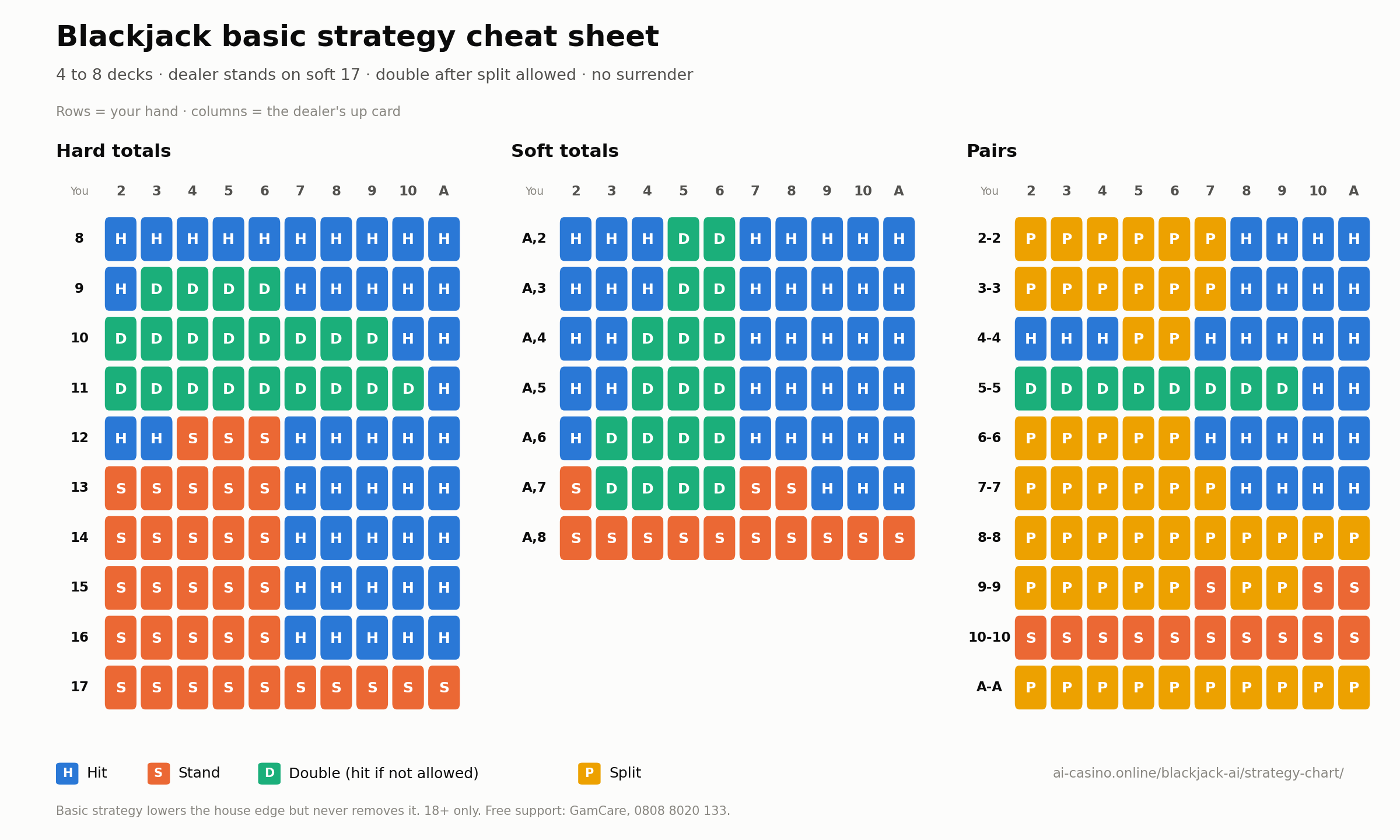
Download the cheat sheet (PNG). If your table uses different rules, flip the toggles above and follow the live chart instead.
Before you sit down
A chart only helps if it matches the table in front of you, so spend ten seconds on the rules card first.
FAQ
Strategy chart FAQ
What does each letter on a blackjack strategy chart mean?+
H means hit, S means stand, D means double down, P means split, and Rh means surrender if it's offered, otherwise hit. Your hand runs down the side of the chart, the dealer's up card runs along the top, and the cell where they meet is the mathematically best play for that combination.
Does the chart change if the dealer hits on soft 17?+
Yes, but only in three cells. When the dealer hits soft 17 (H17) rather than standing (S17), you double 11 against an ace, double soft 18 against a 2, and double soft 19 against a 6, all of which are stands or hits under S17. Everything else on the chart stays the same.
Should I memorise the whole chart, or just carry a copy?+
For occasional play, carrying or checking a copy at the table is fine, almost every casino allows it between hands. For anyone playing regularly, memorising it pays for itself quickly, since deviating from it in either direction hands the house extra edge on top of what it already has.
Is using a strategy chart at the table considered cheating?+
No. Basic strategy is public, well documented mathematics, and using a printed chart or a phone between hands is allowed at essentially every casino, online or in person. What's prohibited is a device that reads or predicts the shoe in real time during play, which a static strategy chart doesn't do.
Why does the chart say to split 8s even against a dealer's 10?+
A hard 16 is one of the worst hands in blackjack regardless of what the dealer shows, it loses more often than it wins whether you hit or stand. Splitting turns that one bad 16 into two hands starting from 8, each with a real chance to improve, which loses less money on average than playing the 16 as a single hand, even against a strong dealer card.
Does the strategy chart change based on how many decks are in the shoe?+
Yes, a handful of cells shift with deck count, mostly around doubling down and surrender decisions, because a single or double-deck shoe has less card variety left than a 6-8 deck shoe. The chart on this page is built for the 6-8 deck ruleset most common online and in most UK casinos, so if you're playing a single or double-deck table specifically, check a chart built for that deck count rather than assuming this one applies exactly.
Keep exploring
More casino AI tools & calculators
More Blackjack AI tools
Other games